My rant was the result of increasing frustration with the one-dimensionality that those who report on, invest in, and build consumer Internet services talk about success.
----------
Medium had its biggest week ever last week — or so we might claim. By number of unique visitors to medium.com, we blew it out of the park. The main driver was a highly viral post that blew up (mostly on Facebook). However, the vast majority of those visitors stayed a fraction of what our average visitor stays, and they read hardly anything.
That’s why, internally, our top-line metric is “TTR,” which stands for total time reading. It’s an imperfect measure of time people spend on story pages. We think this is a better estimate of whether people are actually getting value out of Medium. By TTR, last week was still big, but we had 50% more TTR during a week in early October when we had 60% as many unique visitors (i.e., there was way more actual reading per visit).
--------
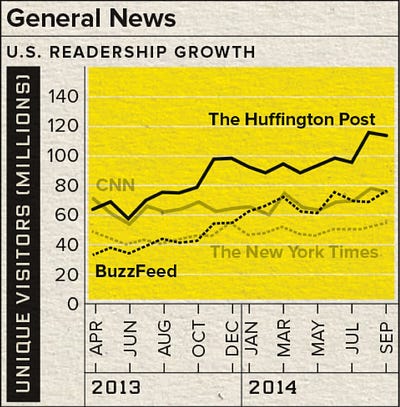
From Wired: http://www.wired.com/2014/12/new-media-2/#slide-id-1674851:full By this metric (misleadingly labeled “readership”), Buzzfeed is “bigger” than The New York Times.But that’s the exact same metric that would tell us last week was bigger for Medium than that week in October. Even if all we care about is attention — not any other value that may be important— this doesn’t tell us much. MaybeBuzzFeed gets more attention, total, than The Times. But we should stop purporting that one-dimensional graphs like this tell us that.
-------
We pay more attention to time spent reading than number of visitors at Medium because, in a world of infinite content — where there are a million shiny attention-grabbing objects a touch away and notifications coming in constantly — it’s meaningful when someone is actually spending time. After all, for a currency to be valuable, it has to be scarce. And while the amount of attention people are willing to give to media and the Internet in general has skyrocketed — largely due to having a screen and connection with them everywhere — it eventually is finite.
We’re not alone in this view. Chartbeat’s Tony Haile has done a great job ofpromoting the idea of an “Attention Web” (as opposed to the “Click Web”). He’s hopeful a shift to measuring attention will improve the web: Upworthy is also beating the time-means-quality drum:
And in that Wired article, they mention why time is more valuable if you’re in the ad business:
For quality publishers, valuing ads not simply on clicks but on the time and attention they accrue might just be the lifeline they’ve been looking for. Time is a rare scarce resource on the web and we spend more of our time with good content than with bad. Valuing advertising on time and attention means that publishers of great content can charge more for their ads than those who create link bait.
We love thinking this way because it rewards us for sharing content that people really enjoy and find valuable — not just stuff they click on a lot. It may mean that we don’t do quite as well on uniques or pageviews, but that’s a tradeoff we’re happy to make because this is a metric focused on real user satisfaction.
Your clicks are valuable, and your eyeballs are valuable, but to advertisers your time is the most precious commodity of all — and publishers say they want to sell ads based on the time readers spend on their sites, not mere pageviews. So, the logic goes, the more time you spent with a story, the more expensive the accompanying ads would be.
Instagram is indeed larger than Twitter if you look solely at monthly active users, of whom Twitter has 284 million at last count. MAUs, as they’re called, are one useful metric of a social network’s size. But they aren’t the only one. Others might include the amount of time users spend on the network, the amount of content they post, and the number of people who see that content. Look at those, and it quickly becomes impossible to say whether Instagram or Twitter is larger.
The question is what to measure and what metrics are most relevant to the platform. Is an instant glancing at a photo equivalent to engaging in a conversation or taking an action after seeing a Twitter post?
More here on this subject: https://medium.com/@ev/a-mile-wide-an-inch-deep-48f36e48d4cb#.nvdt1d7it
STB, responsible for the planning and implementation of promotional activities for Slovenia, is one of the national tourist boards which have not only been successfully following the latest developments in digital tourism but also been proactive in using them to fully engage their customers and their partners. The Board’s established online presence included successful initiatives such as a series of Facebook Campaigns for key markets, which resulted in high awareness, sales turnover and partner satisfaction. Another progressive initiative as far as the social media approach by tourism destinations was concerned was the joint social media platform named DiscoverSlovenia.
Project Overview
In 2011, STB decided to commission the preparation of the strategy order to take its marketing activity to the next level, broadening the range of channels through which the Slovenian tourism product could be accessed and exceed the expectations of today’s online travel consumer, aiming to become a benchmark for European National Tourism Organisations.
In the light of the latest developments in the social media arena, the goal was to
raise awareness of Slovenia as a tourism destination online and support the brand,
increase the visitation numbers in its social media channels and website and digital communication while,
forge a unified, coordinated and practical social media marketing and management model to guide the entire organization through the latest digital developments.
Considering the growing popularity, variety and use of social media channels and given the challenging funding environment most of DMOs are facing, it is necessary to prioritize different areas of digital marketing, including social media channels, and have a well-planned, well executed and results oriented investment plan.
“Integration of digital and traditional media is a key goal for a successful destination marketing strategy, says Manolis Psarros, TEAM Associate & Project Leader/abouTourism Managing Director. “In regards to the Social Media Strategy for STB, great emphasis was placed on brand integration in all planned activities while developing social media workflows and inter-developmental cooperation plans in order to enhance all relevant processes and ensure the effective implementation of the strategy, maximizing social media benefits.”
Digital media and technologies now affect every single stage of the visitor’s journey to a destination, during his stay and even after this. The purpose, throughout this project was to develop a holistic digital marketing strategy targeting the decision-making process of planning a trip to Slovenia, providing useful visitor info while being in Slovenia and utilizing attractive social media tools for sharing their memorable experience upon their return home.
As far as marketing integration is concerned, results until now have shown that social media activities can only be effective when they are interwoven with existing traditional media marketing efforts as an integral part of their overall marketing strategy.
Project Processes
Based on this perspective, STB’s Social Media Marketing Strategy was developed in two phases.
The first phase consisted of the situation analysis which was performed through consultation workshops with the Board’s relevant departments and partners as well as through extensive research providing:
An assessment and analysis of Slovenia’s online presence and digital marketing activities
A review and evaluation of the Board’s operational procedures
The second phase, saw the development of the strategy which included the following:
Selection of appropriate social media channels where STB should invest based on the available resources and the set goals and objectives
Development of an appropriate content management strategy to accompany every channel’s guidelines
Specific digital media operational plan with appropriate resources and activities definition in order to ensure practical implementation
A partnership development plan focusing on travel-related digital media and tourism stakeholders following an established TEAM model, and
Monitoring and tracking guidelines. By monitoring the digital environment relating to Slovenia as a destination and by tracking the performance of STB’s marketing efforts through specific KPI’s, the aim was to validate the feedback/insights for further review and to fine tune the digital marketing strategy.
Tinkara Pavlovcic Kapitanovic, STB’s Head of e-Business and Strategic Projects, commented: “as the NTO we should know and understand what to expect from social media engagement, what are the goals to be achieved and that social media should be seen and handled as a part of the overall online activity of every tourism organization”. Measuring results is critical and is now integral to STB’s work.
In the presentation below we can see how the strategy has been put into effect being used as the basis for coordinated social media marketing efforts and effective implementation of targeted marketing initiatives, relating product developments to identified audience needs.